18 Years Mother Jones From Never Again to Oh Well
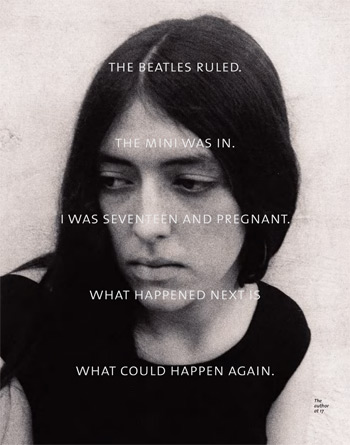 The author at 17. In 1959, when I was a precocious smarty-pants still in grade school, I wrote a simulated letter to Doris Blake, the New York Daily News advice columnist. I pretended to be a teenage girl "in trouble." I spun a tale of a liquor-soaked prom night and passing out in the back of a motorcar. I included a bandage of entirely fictional characters—a worthless boyfriend, a mentally unstable mother, a strict, brutal father. I concluded my letter of the alphabet with: "Now I think I am meaning. Delight assist me. I am desperate."
I'g not certain what I expected, merely my letter was non printed, and no advice was forthcoming. The silence was utter. Possibly Miss Blake, like Nathanael W's Miss Lonelyhearts, had a drawer where such letters were tossed. If and then, the other letters in that drawer were no dubiousness a lot like mine—except that they were not written by wiseass children. They were real. And for the writers of those messages, the silence was existent. And I remember thinking: Gee, what if I really were that daughter I made upward? What would I do?
One summer nighttime some years later, when I was not quite 18, I got knocked up. There was nothing exciting or memorable or fifty-fifty interestingly sordid almost the sex. I wasn't raped or coerced, nor was I madly in honey or drunkard or high. The guy was another child, really younger than I, merely a friend, and information technology pretty much happened by default. We were horny teenagers with nada else to exercise.
Nature, the ultimate unsentimental pragmatist, has its own notions about what constitutes a quality liaison. What nature wants is for sperm and egg to meet, as oft every bit possible, whenever and wherever possible. Whatever information technology takes to expedite that coming together is fine with nature. If it's 2 people with a bassinet and a plant nursery all decorated and waiting and a shelf total of infant books, fine. If it'south a 12-year-old girl who's been married off to a seventy-year-old Afghan chieftain, fine. And if it's a couple of healthy young oafs like my friend and me, who knew perfectly well where babies come from simply just got stupid for nearly fifteen minutes, that's fine, too.
In the movies, newly significant women trip, autumn downward the stairs, and "lose the babe." Ah. If but it were that easy. In real life, once that egg is fertilized and has glided on down the fallopian tube, selected its nesting place, and settled in, information technology'due south notoriously secure, behaves like visiting royalty. Nature doesn't give a fig about the hostess's feelings of hospitality or lack of them. If the zygote's not defective, and the woman is in good health, virtually zero will shake it loose. Anyone who'due south been significant and didn't want to be knows this is and then.
On November 5, 2003, three decades after Roe v. Wade established a woman's constitutional right to terminate a pregnancy, President George W. Bush signed the Partial Birth Abortion Ban bill into constabulary. We've all seen the photograph: The president sits at a table with a small-scale little smile on his lips. Nine guys—senators and congressme—stand behind him, watching that signature go onto the paper, light-headed grins on their faces. They look nigh goofy with joy.
Two of these happy fellows are actually Democrats: Jim Oberstar and Bart Stupak. The rest are Republicans to their marrow: the bill'southward sponsor, Rick Santorum, also every bit Steve Chabot, Orrin Hatch, Henry Hyde, Tom DeLay, Mike DeWine, and Dennis Hastert.
Exist bodacious that it's not merely "partial-nativity" abortion they're so happy about passing a police force against. It'southward all the police heralds. Similar some ugly onetime wall-to-wall carpet they've been yearning to become rid of, they finally, finally loosened a piddling corner of Roe. At present they can beginning to rip the whole thing up, roll it dorsum completely, and toss it in the Dumpster.
For with the PBAB, Bush-league and Co. have accomplished the kickoff federal legal erosion of Roe v. Wade since its adoption in 1973. Roe states that a woman may cease a pregnancy up to the bespeak of "viability," approximately 24 weeks. Afterwards that, states may prohibit or restrict abortion, just exceptions must be fabricated to preserve "the life or health of the woman." The PBAB has been around the block before—in 1995, 1997, 1999, and 2000. What stopped it before was e'er the fence over allowances for women's health. President Clinton vetoed information technology three times because it disallowed exceptions to foreclose serious disabling injury to the woman. But when the bill came up over again in 2002, allowances for prevention of disabling injury to the mother were left out, as were those for rape and incest. A "fractional-nascency" abortion would be permitted just as a final resort to save the mother's life, or if the fetus was already dead. In other words, the risk of permanent injury to the woman if she proceeds with the pregnancy is not a skilful enough reason to perform one—not in Santorum's book. She has to be literally on expiry'southward doorstep. A couple of Democrats tried to offer an amendment that brought up that pesky women'due south health result again. The bill's authors objected. Women and their doctors volition just use the subpoena as a loophole! Chabot worried it would create "a phony ban" and Santorum predicted it would be defeated. It was.
Like some ugly sometime wall-to-wall carpeting they've been yearning to get rid of, they finally, finally loosened a piddling corner of Roe. Now they tin can offset to rip the whole thing upward, roll it back completely, and toss information technology in the Dumpster.
I Democratic senator proposed a nonbinding resolution, expressing "…the sense of the Senate that…Roe v. Wade was advisable and secures an important constitutional right and should not be overturned." This amendment passed in the Senate by a 52-46 vote. The House version of the PBAB lacked any such amendment.
In briefing, the Republicans quickly took care of that feeble squeal on behalf of Roe: They merely deleted it. When the pecker landed on Bush-league'south desk, the resolution to reaffirm Roe was gone.
What, you might ask, is "partial-birth" abortion? Almost of united states know that the term is not a medical one. Invented by the pro-life folks in the last decade or then, it's a vague reference to "intact dilation and extraction," or D&X. Introduced in 1992, D&Ten is a variation on a like, well-established 2nd- (and sometimes tertiary-) term procedure—"dilation and evacuation," or D&E—used later the fetus has grown too large to be vacuumed or scraped out in a simple D&C, or "dilation and curettage."
In a D&E, the fetus is normally dismembered inside the uterus and extracted in pieces. One-time obstetrics books from as far dorsum as the 1700s take disquieting illustrations of the various tools of yore used for fetal dismemberment. Present, powerful gripping forceps are used, making the procedure much less dangerous for the woman.
The D&X was developed with the same objective. An inherent hazard of D&Eastward—aside from potential damage past the instruments themselves and the take a chance of leaving tissue behind, increasing the chances of infection—is that fetal bones begin to calcify at nigh xiii weeks. As they are cleaved up, the sharp os ends can puncture, scrape, and perforate. Hence the "intact" dilation and extraction. The fetus is brought out whole instead of existence pulled apart bit by chip. The head is punctured and and so collapsed by suction or compression so that it will fit through the partially dilated cervix. The fetus is expressionless, but in i slice. This, specifically, is the procedure the PBAB has sought to criminalize—when the fetus is killed while its body is outside the uterus, therefore "partially born."
Nether the PBAB of 2003, a D&X would be permitted only to relieve the woman's life or if the fetus is dead. It would require a girl who'd been impregnated by her uncle, begetter, or brother, and who, out of shame, ignorance, and fear had hidden her condition until information technology was obvious to the earth, to acquit the fetus to term and give nascency. If a woman discovers, late in her pregnancy, that the fetus has, say, anencephaly—a encephalon stem just no actual brain—so she must deport it to term, give birth, and permit it die on its own.
Since pulp descriptions of fractional-birth abortion accept been so effective in rallying support for the bill, perhaps some remainder is needed. I've read and heard hundreds of accounts of pre-Roe ballgame, and there was a wide range of danger, squalor, sanitary weather, provider skill, follow-upwardly care. The well-heeled and well-connected often flew to Puerto Rico or Sweden and checked into clinics. Of the ones who couldn't do that, some were lucky plenty to observe competent, compassionate doctors. Some were treated kindly and recovered without incident. The other extreme was pain, terror, and death worthy of the Inquisition. A typical picture emerges, though, and it matches up just about perfectly with a story told to me past a woman I know.
A doctor friend there said he couldn't help her himself, but sent her to a local prostitute who did abortions. The prostitute had her own speculum. The process was done on the prostitute's bed: The catheter was inserted through the cervix and left there.
After a date rape (by a "poet") during a trip to Paris in 1967 when she was 23, she found herself pregnant. She tried the usual "remedies"—scalding hot baths, violent jumping, having someone walk on her belly. When she got home to Minnesota, she was ii months along. A medico friend there said he couldn't help her himself, just sent her to a local prostitute who did abortions.
The prostitute had her own speculum. The procedure was done on the prostitute'south bed: The catheter was inserted through the cervix and left at that place. Afterwards four days of high fever, chills, haemorrhage, and passing big chunks of tissue, she landed in the hospital. They said her uterus was perforated, that she had acute peritonitis and an "incomplete" ballgame. She was given a huge dose of penicillin and treated as if she were some sort of contemptible lower life form. The emergency-room dr. snarled, "What have you washed to yourself?" Later on, she realized that the outset doctor—her friend—had known all along that she'd probably go desperately ill. But then could a hospital legally give her a D&C.
She recovered—sterile, violently allergic to penicillin, and then "paralyzed and ashamed" past the experience that she stayed away from men for iv years. Who says deterrence doesn't work?
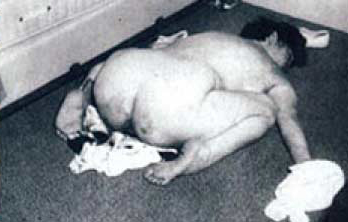 Originally taken by a police officer in Norwich, Connecticut in June 1964 and published past Ms. magazine in Apr 1973. Wikimedia Then in that location's the famous 1964 police force photograph of a woman's corpse on a motel-room floor in Connecticut. She'south kneeling naked, face downwardly as if to Mecca, legs bent to her breast, encarmine towels bunched nether her. The case had fabricated local headlines, merely the picture wasn't seen by the general public until Ms. Magazine ran it in a 1973 article lauding the ruling of Roe v. Wade. Details emerged about the woman'due south life and expiry: She was 27, married with two young daughters, but estranged from her vehement husband. Her lover had performed the abortion, using borrowed instruments and a textbook. When she started hemorrhaging, he panicked, fled the motel, and left her there.
Compared to those two women, I got off piece of cake. Past the eye of September, I'd missed two periods and my cigarettes were tasting peculiar. I was jump for freshman year at higher in Boston, though, and so I just ignored the facts and went off to school. It took a third missed period and near throwing up in the backseat of a car packed with kids to penetrate my adolescent thick headedness.
I had a savvy friend in New York, Kat, who only dated rich older men. I figured she'd be the one to call. Soon a long ride on buses and trains took me out to a firm in a Boston suburb. The doc'southward wife answered the door. There was no waiting room, no magazines, no other patients. The house was completely ordinary, perchance a affect run-down. She showed me into a room off the front end hall and vanished.
Except for a pocket-sized sink, the office was but a regular room, a parlor, with green walls and venetian blinds and a worn rug on the floor. A tall, battered, glass-doored porcelain cabinet stood in a corner. Through the drinking glass, I could see on the shelves a dusty disorderly jumble of stethoscopes, hypodermics, bottles, picayune safe hammers, basins, forceps, clamps, speculums, wads of cotton. At that place were rust stains in the sink and a tired old examining table.
The md, a lilliputian nervous man with glasses and a bald head, came in. I explained my problem. I accept to examine yous, he said. And he said: Everything has to exist clean, very make clean. He went to the sink and washed and washed his hands.
He finished and stood there without saying annihilation. His eyes were sort of glittering behind his spectacles, and he acted as if I was supposed to know what to exercise next. I glanced around for a gown, but he was looking impatient, and so I only took off my underwear and climbed onto the table.
He didn't carp with a glove. He poked around a while, and so told me that I'd waited too long, I was too far gone, information technology would be too risky for him, and that would be $25.
He didn't bother with a glove. He poked around a while, then told me that I'd waited too long, I was as well far gone, it would be too risky for him, and that would be $25.
And I was back out on the suburban street, the door shut firmly behind me.
Kat told me to come up to New York and bring $500. I slept on the burrow in her apartment. Kat'southward roommate, Elaine, gave me the address of a doctor over in Jersey City. I took a train and walked 10 blocks to a street of old brownstones, some of them with their windows boarded upwardly. There had been no calling ahead for an "date"; you were supposed to just testify upwards.
This doctor had a waiting room, with dark walls and a very high ceiling, the forepart room of the brownstone. It was full of people, facing each other along opposite walls, sitting in sometime, cracked, dark-brown leather parlor chairs with stand-up ashtrays hither and there, like in a bus station. A set of tall sliding wooden doors stood closed between that room and the next. Everyone was smoking, including me. The air was blue.
Several Puerto Rican-looking women chattered abroad in Spanish and seemed perfectly cheerful. At that place were a few men, who looked as if they might be accompanying somebody, and some more women who sat silent and staring.
And there was a couple who stood out like a pair of borzoi among street mutts: a homo and adult female, tall, slim, expensively dressed WASPs, faces grim, looking like people who'd taken a seriously wrong turn off the highway. I remember feeling deplorable for them.
The tall wooden doors separated. A potbellied man in shirtsleeves who resembled Harpo Marx minus the fun stood at that place. His eyes moved around the room. He looked at the Puerto Rican women, the tall WASP woman, then at me, then the WASP woman again, considered for a moment, turned back to me, and pointed.
You lot, he said.
I got up and went in. He slid the doors shut. We were alone.
The windows in here had been nailed over with plywood, and the floor was aboriginal linoleum. At that place was a odor of insecticide. Boxes and bundles of newspaper were piled loftier in the dim corners and on a rolltop desk, and forth the walls were shelves crammed messily with stethoscopes, hypodermics, speculums. The examining tabular array was the centerpiece of the room, antique and massive, from the last century, dark greenish leather, steel and ceramic, designed then that the patient did not lie flat but in a semi-reclining position. Instead of stirrups, there were obstetrical leg supports. A tall onetime-fashioned floor lamp with a rose silk shade and a fringe, the only light in the room, stood next to the table alongside a cylinder of gas. An unlit crystal chandelier dangled in the overhead shadows.
Be here at seven o'clock in the evening. Requite me one hundred dollars at present because this will exist difficult. You tin pay the rest when you come back. Bring cash. Five hundred more than.
The doc had a trace of some sort of European accent. German, I guessed. He was about a human foot shorter than I was, and behaved with obsequious deference, as if I had dropped in for an afternoon sherry. He gestured toward the examining table with a ladylike flourish. I sabbatum between the leg supports while he stood close and asked questions: Last flow, how many times had I had sex, was I married, how many men had I had sex with, did they have large or pocket-sized penises, were they circumcised, what positions, did I similar it?
He moved the floor lamp closer. I put my legs in the apparatus and looked up at the chandelier.
He didn't bother with a glove, either. He thrust several fingers in, difficult, then I could experience the scrape of his nails.
Ouch! I said politely.
Ouch, he mocked. Never mind your ouch. He pushed his fingers in harder and pressed down on my belly with his other hand.
Yous are very far forth, he said. It volition be a very hard process. Come back tomorrow. Exist hither at seven o'clock in the evening. Give me one hundred dollars now because this volition be hard. Y'all can pay the remainder when you come back. Bring cash. 5 hundred more.
I borrowed the extra hundred from Kat, and enlisted someone I knew to ride out to Jersey City with me on the train, a guy who was something of an ex-swain. Even though I was enigmatic about why we were going to Jersey Urban center at night, he guessed what was up, and seemed fairly entertained at the prospect.
This fourth dimension, there was no one in the waiting room. The doctor looked very annoyed when he saw that I wasn't alone. My friend stayed out in that location while I went into the office. The doctor locked the door behind us.
The doctor stood next to me, leaned on me heavily, and rubbed his 2 easily up my thigh, all the way up, and so that his fingertips collided with my crotch. I understood then that he'd known perfectly well on my last visit that he wasn't going to go through with information technology.You lot are a cute daughter, a beautiful girl, he breathed moistly onto my face as his hands slid up and down, upwardly and down.
When I was on the table, he stood betwixt my legs and pressed and ground his pelvis against me and then put his fingers in for a while.
And so he said: You are besides far gone. I cannot practice it.
I put my legs downward and sabbatum up. He stood next to me, leaned on me heavily, and rubbed his two hands upward my thigh, all the mode up, so that his fingertips collided with my crotch. I understood then that he'd known perfectly well on my concluding visit that he wasn't going to go through with it.
You are a beautiful girl, a beautiful daughter, he breathed moistly onto my face equally his hands slid up and down, up and down. Information technology is too belatedly. Accept my advice. Have the infant. Have the baby.
He unlocked the sliding doors and beckoned my friend in.
Get married, he said. Have the baby.
Hey, I'thou not the guy, said my friend.
What about my hundred dollars? I asked.
Go out of here, the doctor said, and turned his dorsum.
When we got to my friend's train stop, he walked off whistling a jaunty tune. Good luck, he said, and was gone.
Today, chat rooms and message boards related to abortion evidence a disturbing trend among some young people: Not only is disinformation rife ("The just reason abortion is still legal," writes 1 correspondent, "is becuz the babies organs are prossed and some of that coin is forwarded to the libral party."), merely many immature people haven't the remotest notion of pre-Roe reality. Abortion's been legal since earlier they were born. Some even believe that abortion was invented with Roe v. Wade.
Abortion was not e'er illegal before Roe. Into the 19th century, what a woman did with her early pregnancy was considered a purely domestic affair. Until "quickening," when the fetus was perceived to be alive and kicking, it wasn't even considered a pregnancy, but a "blocking" or an "imbalance," and women regularly "restored the menses," if they so chose, through plants and potions. Abortifacients became commercially available past the mid-1700s.
Quality control was non neat, and the earliest abortion legislation, in the 1820s and '30s, appears to have been an endeavour to curtail poisoning rather than abortion itself. According to several historians of the result, as ballgame—both through drugs and directly procedures—became a bigger and bigger commercial venture, "orthodox" physicians, who were competing with midwives, homeopaths, and self-styled practitioners of all stripes, pushed to make ballgame illegal. The nascent American Medical Association established its dominance over lay practitioners through abortion laws, and women were kept in their identify. Eugenics played a role, too: With "undesirables" breeding prolifically, motherhood was hailed as a white adult female'south patriotic duty, ballgame a form of treason. Past the mid-1800s, most of the "folk" knowledge had been lost and abortion became "infanticide." Betwixt 1860 and 1880, antiabortion laws spread urban center by city, country by land. Now in that location was a ruthlessly pragmatic attribute: In the aftermath of the slaughter of half a million men during the Ceremonious War, the births were needed. Get-go the men were conscripted, then the women.
Into the 19th century, what a woman did with her early on pregnancy was considered a purely domestic matter. Until "quickening," when the fetus was perceived to be alive and kick, it wasn't even considered a pregnancy.
Demand for abortion continued to grow in spite of the laws. Periods of relative tolerance gave way to periods of stricter enforcement, which inevitably corresponded to periods of women's activism. In the late 19th century, information technology was when they demanded a voice in politics. Subsequently World War 2 and through the 1960s, information technology was when they demanded sexual freedom. All kinds of change, rebellion, and upheaval were busting out and then, and the reflexive reaction of the regime was to fissure down. For women getting illegal abortions, this era was particularly marked past fearfulness, secrecy, ignorance, shame, and danger. This was the era that put the rusty coat hanger into the commonage consciousness.
The day subsequently I returned from Jersey City, there was another doctor in a seedy piffling basement office in New York, who didn't fifty-fifty impact me. He said the just fashion to do information technology at this signal would be to perform a miniature caesarean, non something he could do in his role.
Kat and Elaine were plainly getting tired of having me and my problem on their couch. They came upwards with a phone number in Florida. I called. A male person vox said I should fly to Miami. They'd encounter me and take me to one of the islands, to a dispensary. Give the states the telephone number of where you're staying now in New York. Nosotros'll telephone call you dorsum and confirm the arrangements.
He chosen back within an hour. It was fix: Wing to Miami next Th, between the hours of noon and 5. Wear something vivid cherry-red so nosotros'll know you when yous get off the aeroplane. And bring 8 hundred dollars, in greenbacks.
I concluding affair, he said. You must not tell anyone where you're going.
They understand that I'm over three months, correct? I said.
Yes, yeah. They know. Information technology's all set.
I hung upwardly. This didn't feel expert at all. Florida, the islands, wads of cash, distant voices.
I idea about doing what I should take washed in the commencement place: calling my mother.
Not calling her in the beginning wasn't because my mother was a prude or religious or anything like that. Inappreciably. It was because I was naturally secretive, had wanted to take care of things on my own. I simply wanted information technology to go abroad. Simply at that place was a limit to fifty-fifty my pigheadedness. I thought about how sad it would make my female parent if I simply disappeared. My female parent, who was right there in the city, swung into action instantly. She made arrangements with a medico she knew, and borrowed the $ane,500 it would toll because of the added chance.
This doctor had a make clean, mod office in Midtown. He drew a diagram showing the difference between a first-trimester D&C and what I'd exist having. After three months, he said, the placenta and the blood vessels that feed it grow too circuitous to simply be scraped out. To do and then would be to just near guarantee a hemorrhage. In a normal birth or miscarriage, he said, the uterus contracts, shearing off the placenta and pinching off the connecting claret vessels. We induce a miscarriage, he said, by injecting a saline solution into the amniotic sac. The fetus dies. The uterus rejects information technology past contracting. That style, no hemorrhage. Then we get in and take information technology out. If it were done any other way, it could easily impale you.
A engagement was made for the following week. I was off of Kat and Elaine's couch and on my mother's.
1 evening, my mother'due south telephone rang. It was the man in Florida. He'd tracked me down through Kat, and he was angry. What the hell had happened? Where was I? They'd waited all day at the airport in Miami, met every plane. I apologized, told him I'd made other arrangements hither at home. He said I was a fucking bitch who owed money to him and a lot of other people, told me to go fuck myself, and hung upwards.
Perhaps everything would have been peachy if I'd gone to the islands. Maybe I'd have come back with a tan and heartwarming stories of kindness and caring that I'd remember fondly through the years. A rather different picture always comes to listen, though, and information technology involves a morgue in a run-down lilliputian infirmary with heat and flies, and then a dinghy with an outboard, or maybe a fishing gunkhole with a rumbling, smoky diesel engine, heading out into the Caribbean at night bearing a largish canvas purse weighted with cinder blocks….
That year in the 1960s, several m American women were treated in emergency rooms for botched abortions, and there were at least 200 known deaths. Comparing my story with others from the pre-Roe era, what impresses me is how shut I veered to mortal danger in spite of not living under most of the usual terrible strictures. Unlike so many of the women I've read nigh and talked to, especially the teenagers, I was quite unburdened by shame and guilt. I'd never, e'er had the "nice girls don't do it" trip laid on me. I came from a religion-free background. I wasn't worried in the least nearly "sin," was not at all ambivalent about whether abortion was right or wrong. I wasn't sheltered or ignorant. I didn't face up parental disapproval or stigmatization of any kind. I had no angry husband. My mother would have leapt in and helped me at any point. There was no demand at all to continue my condition surreptitious and to procrastinate, but I did information technology anyway. What does this say well-nigh how it was for other young girls and women who didn't take my incredible luck? I was luckier than most in another department, too—existence raped by the abortionist was a major hazard of the era. I merely got diddled by a couple of disgusting old men. Information technology was nasty and squalid, simply information technology certainly didn't kill me. As I said, I got off easy.
That year in the 1960s, several thousand American women were treated in emergency rooms for botched abortions, and there were at least 200 known deaths. I got off easy.
Ironically, information technology was the medical profession, which had made ballgame illegal in the first place, that started to speak out. Doctors treating the badly sick women who landed in hospitals with raging peritonitis, hemorrhages, perforated uteruses, and septic shock often had to futilely spotter them die, considering the women had waited as well long to get assist—because they were confused and terrified, considering what they had done was "illegal" and "immoral."
One md's "enkindling" is vividly described in The Worst of Times, a collection of interviews with women, cops, coroners, and practitioners from the illegal abortion era. In 1948, when this doctor was an intern in a Pittsburgh hospital, a adult female was admitted with severe pelvic sepsis after a bad ballgame. She was beautiful, married to someone important and wealthy, and already in renal failure. Over the next couple of days, despite heroic efforts to salvage her, a cascade of systemic catastrophes due to the overwhelming infection culminated with the small blood vessels bursting under her skin, bruises breaking out everywhere as if some invisible fist were punching her over and over, and she died. Being well-to-exercise didn't always salve you.
Her expiry was then horrible that it made him, he recalls, physically ill. He describes his anger, but says he didn't quite know with whom to be angry. Information technology took him another 20 years to understand that information technology was not the abortionist who killed her—information technology was the legal system, the lawmakers who had forced her away from the medical community, who "…killed her just every bit surely as if they had held the catheter or the coat hanger or whatever. I'yard notwithstanding angry. It was all so unnecessary."
All so unnecessary.
In the same book, a man who assisted in autopsies in a big urban hospital, starting in the mid-1950s, describes the many deaths from botched abortions that he saw. "The deaths stopped overnight in 1973." He never saw some other in the 18 years earlier he retired. "That," he says, "ought to tell people something about keeping ballgame legal."
In February 2004, seven ballgame doctors in four states sued Chaser General John Ashcroft, claiming that D&X was indeed a medically necessary procedure. Ashcroft retaliated past subpoenaing their hospitals for the records of all patients who'd had late-term abortions in the past 5 years—most long earlier the PBAB—to determine, ostensibly, if whatever D&Xs had actually been prompted past health risks. In June, a federal estimate in San Francisco declared the PBAB to exist unconstitutional—saying it was vague, placed an "undue burden" on abortion rights, and contained no exception for a woman'due south health—but she did not, in deference to other cases wending their style through the legal arrangement, completely elevator the ban.
"The deaths stopped overnight in 1973." He never saw some other in the xviii years before he retired. "That," he says, "ought to tell people something virtually keeping abortion legal.
One doctor, writing most D&X, said something that particularly struck me—that the bodily practise of medicine, the stuff that goes on behind closed doors, is often gruesome, gory, and messy. Saws whine, bones fissure, blood spatters. We outside of the profession are mostly shielded from this reality. Our model is white sheets, gleaming linoleum, and Dr. Kildare. Confront-lift, hip replacement, featherbed, liver transplant—many people would faint dead abroad at a detailed description of whatsoever of these. Doctors roll up their sleeves, plunge in, and do tough, nervy, drastic, and risky things with our very meat-bone-and-gristle bodies, nether occasionally harrowing circumstances.
The gruesome aspect of D&X has been detailed and emphasized, only as a procedure, it'southward in line with the purpose of medicine: to get a hard mankind-and-blood job done. What makes it dissimilar from other procedures is that it tin can involve a live fetus. This puts it in a class by itself. But the woman undergoing a D&X knows this. If she's doing it, there will be powerfully compelling reasons, and it'due south non for anyone else to decide if those reasons are compelling enough.
Women of all kinds seek and accept always sought abortion: married, single, in their twenties, thirties, and forties, teenagers. Some accept no children, some accept several already. Some never desire children, some desire children later on. They are churchgoers, atheists, agnostics. They are morally upright pillars of the community, they are prostitutes. They're promiscuous, they're monogamous, they're recent virgins. They become pregnant under all kinds of circumstances: consensual sex, nonconsensual sex activity, sexual practice that falls somewhere between consensual and nonconsensual. Some are drunk or using drugs, some never even touch an aspirin. Some utilize no birth control, some utilise birth command that fails.
The desperate teenager I invented in my letter to Doris Blake in 1959 surely had hundreds, maybe thousands, of real-life counterparts at the very moment I put the envelope in the mail. All kinds of women are vulnerable and are affected by the particulars of abortion police, but the ones most profoundly affected are the very young, and it's a one-two punch from both nature and society. First, nature itself conspires to make teenagers defenseless—they're lushly fertile, their brains are flooded with sexual practice hormones, and their judgment, practical noesis, and common sense have been known to be less than perfect.
When a woman does not desire to exist pregnant, the bulldoze to become unpregnant can plough into a force equal to the nature that wants her to stay meaning. And so she will look for an abortion, whether information technology'due south legal or illegal, clean or filthy, safe or riddled with danger. This is merely a fact, whatever our opinion of it.
Teenagers—especially those who are poor and uneducated—are by far the group having the most constituent late-term abortions. If we truly wish to protect the young and vulnerable, promote a "culture of life," as President Bush-league said then grandly in his signing speech, then we must brand teenage girls a top priority. Make certain they don't go pregnant in the beginning identify, and not just by preaching "forbearance merely." If they do get pregnant, don't throw a net of fear, confusion, and complication over them that will only cause them to hide their conditions for as long as they can. Considering that's exactly what they'll do. You could argue that "partial-birth" abortion is the cost a order pays when it calculatedly keeps teenage girls ignorant instead of aggressively arming them with the facts of life and, if necessary, the equipment to protect themselves from pregnancy.
I was inappreciably i of those tragically vulnerable teenagers. I suppose I was the kind of wanton female the lawmakers and wrath-of-God types look down on. There's no doubt that I was stupid and irresponsible, and I certainly knew better than what yous might accept surmised from my deportment. By some standards, I suppose yous could say I was a slut. Those sleazy doctors left no uncertainty that that'due south how they saw me. Some would say I got what I deserved, or that I deserved to die.
The arguments would be countless, but they would be irrelevant to the facts: From the moment I started looking for an abortion, not once did I even consider going through with the pregnancy. Not for one 2d. Information technology just was not going to happen. Nothing, and I mean nix, was going to end me, and it could accept toll me my life. And this is what I had in common with millions and millions of women throughout fourth dimension and history. When a adult female does not want to be significant, the drive to go unpregnant can turn into a force equal to the nature that wants her to stay pregnant. And then she will expect for an abortion, whether it's legal or illegal, clean or filthy, safe or riddled with danger. This is simply a fact, whatsoever our opinion of it. And whether we similar it or not, humans, married and unmarried, volition go along to have sex—wisely, heedlessly, violently, nicely, hostilely, pleasantly, dangerously, responsibly, carelessly, sordidly, exaltedly—and there volition be pregnancies: wanted, unwanted, partly wanted, partly unwanted.
A guild that does not have the facts is a childish society, and a gild that makes abortion illegal—and I believe that the PBAB is a calculated step in exactly that management—is a savage and backward society that makes existence female a criminal offense. It works in partnership with the illegal abortionist. It puts him in business, sends him his customers, and employs him to manipulate rough, dirty, barbaric, savage penalization to those who break the law. And the ones who are punished by the illegal abortionist are ever women: mothers, sisters, daughters, wives.
Information technology's no way to care for a lady.
Source: https://www.motherjones.com/politics/2004/09/way-it-was/
0 Response to "18 Years Mother Jones From Never Again to Oh Well"
Post a Comment