Javalangmethod Invoke Example
- Main Page
- Classes
- Related Pages
- Class List
- Class Hierarchy
- Class Members
java.lang.reflect.Method Class Reference
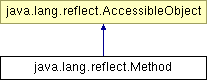
List of all members.
Detailed Description
This class must be implemented by the VM vendor.This class models a method. Information about the method can be accessed, and the method can be invoked dynamically.
Public Member Functions | |
| TypeVariable< Method >[] | getTypeParameters () |
| String | toGenericString () |
| Type[] | getGenericParameterTypes () |
| Type[] | getGenericExceptionTypes () |
| Type | getGenericReturnType () |
| Annotation[][] | getParameterAnnotations () |
| boolean | isVarArgs () |
| boolean | isBridge () |
| boolean | isSynthetic () |
| Object | getDefaultValue () |
| boolean | equals (Object object) |
| Compares the specified object to this Method and answer if they are equal. | |
| Class<?> | getDeclaringClass () |
| Return the Class associated with the class that defined this method. | |
| Class<?>[] | getExceptionTypes () |
| Return an array of the Class objects associated with the exceptions declared to be thrown by this method. | |
| int | getModifiers () |
| Return the modifiers for the modeled method. | |
| String | getName () |
| Return the name of the modeled method. | |
| Class<?>[] | getParameterTypes () |
| Return an array of the Class objects associated with the parameter types of this method. | |
| Class<?> | getReturnType () |
| Return the Class associated with the return type of this method. | |
| int | hashCode () |
| Answers an integer hash code for the receiver. | |
| Object | invoke (Object receiver, Object...args) throws IllegalAccessException, IllegalArgumentException, InvocationTargetException |
| Return the result of dynamically invoking the modeled method. | |
| String | toString () |
| Answers a string containing a concise, human-readable description of the receiver. | |
Private Member Functions | |
| Method () | |
| Prevent this class from being instantiated. | |
Constructor & Destructor Documentation
| java.lang.reflect.Method.Method | ( | ) | [private] |
Prevent this class from being instantiated.
Member Function Documentation
| String java.lang.reflect.Method.toGenericString | ( | ) |
Returns the String representation of the method's declaration, including the type parameters.
- Returns:
- An instance of String.
- Since:
- 1.5
| Type [] java.lang.reflect.Method.getGenericParameterTypes | ( | ) |
Gets the parameter types as an array of Type instances, in declaration order. If the method has no parameters, then an empty array is returned.
- Returns:
- An array of Type instances.
- Exceptions:
-
GenericSignatureFormatError if the generic method signature is invalid. TypeNotPresentException if the component type points to a missing type. MalformedParameterizedTypeException if the component type points to a type that can't be instantiated for some reason.
- Since:
- 1.5
| Type [] java.lang.reflect.Method.getGenericExceptionTypes | ( | ) |
Gets the exception types as an array of Type instances. If the method has no declared exceptions, then an empty array is returned.
- Returns:
- An array of Type instances.
- Exceptions:
-
GenericSignatureFormatError if the generic method signature is invalid. TypeNotPresentException if the component type points to a missing type. MalformedParameterizedTypeException if the component type points to a type that can't be instantiated for some reason.
- Since:
- 1.5
| Type java.lang.reflect.Method.getGenericReturnType | ( | ) |
Gets the return type as a Type instance.
- Returns:
- A Type instance.
- Exceptions:
-
GenericSignatureFormatError if the generic method signature is invalid. TypeNotPresentException if the component type points to a missing type. MalformedParameterizedTypeException if the component type points to a type that can't be instantiated for some reason.
- Since:
- 1.5
| Annotation [][] java.lang.reflect.Method.getParameterAnnotations | ( | ) |
Gets an array of arrays that represent the annotations of the formal parameters of this method. If there are no parameters on this method, then an empty array is returned. If there are no annotations set, then and array of empty arrays is returned.
- Returns:
- An array of arrays of Annotation instances.
- Since:
- 1.5
| boolean java.lang.reflect.Method.isVarArgs | ( | ) |
Indicates whether or not this method takes a variable number argument.
- Returns:
- A value of
trueif a vararg is declare, otherwisefalse.
- Since:
- 1.5
| boolean java.lang.reflect.Method.isBridge | ( | ) |
Indicates whether or not this method is a bridge.
- Returns:
- A value of
trueif this method's a bridge, otherwisefalse.
- Since:
- 1.5
| Object java.lang.reflect.Method.getDefaultValue | ( | ) |
Gets the default value for the annotation member represented by this method.
- Returns:
- The default value or
nullif none.
- Exceptions:
-
TypeNotPresentException if the annotation is of type Class and no definition can be found.
- Since:
- 1.5
| boolean java.lang.reflect.Method.equals | ( | Object | object | ) |
Compares the specified object to this Method and answer if they are equal.
The object must be an instance of Method with the same defining class and parameter types.
- Parameters:
-
object the object to compare
- Returns:
- true if the specified object is equal to this Method, false otherwise
- See also:
- hashCode
| Class<?> java.lang.reflect.Method.getDeclaringClass | ( | ) |
Return the Class associated with the class that defined this method.
- Returns:
- the declaring class
| Class<?> [] java.lang.reflect.Method.getExceptionTypes | ( | ) |
Return an array of the Class objects associated with the exceptions declared to be thrown by this method.
If the method was not declared to throw any exceptions, the array returned will be empty.
- Returns:
- the declared exception classes
| int java.lang.reflect.Method.getModifiers | ( | ) |
Return the modifiers for the modeled method.
The Modifier class should be used to decode the result.
- Returns:
- the modifiers
- See also:
- java.lang.reflect.Modifier
Reimplemented from java.lang.reflect.AccessibleObject.
| String java.lang.reflect.Method.getName | ( | ) |
Return the name of the modeled method.
- Returns:
- the name
| Class<?> [] java.lang.reflect.Method.getParameterTypes | ( | ) |
Return an array of the Class objects associated with the parameter types of this method.
If the method was declared with no parameters, the array returned will be empty.
- Returns:
- the parameter types
| Class<?> java.lang.reflect.Method.getReturnType | ( | ) |
Return the Class associated with the return type of this method.
- Returns:
- the return type
| int java.lang.reflect.Method.hashCode | ( | ) |
Answers an integer hash code for the receiver.
Objects which are equal answer the same value for this method. The hash code for a Method is the hash code of the method's name.
- Returns:
- the receiver's hash
- See also:
- equals
| Object java.lang.reflect.Method.invoke | ( | Object | receiver, | |
| Object... | args | |||
| ) | throws IllegalAccessException, IllegalArgumentException, InvocationTargetException |
Return the result of dynamically invoking the modeled method.
This reproduces the effect of receiver.methodName(arg1, arg2, ... , argN) This method performs the following:
- If the modeled method is static, the receiver argument is ignored.
- Otherwise, if the receiver is null, a NullPointerException is thrown. If the receiver is not an instance of the declaring class of the method, an IllegalArgumentException is thrown.
- If this Method object is enforcing access control (see AccessibleObject) and the modeled method is not accessible from the current context, an IllegalAccessException is thrown.
- If the number of arguments passed and the number of parameters do not match, an IllegalArgumentException is thrown.
- For each argument passed:
- If the corresponding parameter type is a base type, the argument is unwrapped. If the unwrapping fails, an IllegalArgumentException is thrown.
- If the resulting argument cannot be converted to the parameter type via a widening conversion, an IllegalArgumentException is thrown.
- If the modeled method is static, it is invoked directly. If it is non-static, the modeled method and the receiver are then used to perform a standard dynamic method lookup. The resulting method is then invoked.
- If an exception is thrown during the invocation it is caught and wrapped in an InvocationTargetException. This exception is then thrown.
- If the invocation completes normally, the return value is itself returned. If the method is declared to return a base type, the return value is first wrapped. If the return type is void, null is returned.
- Parameters:
-
receiver The object on which to call the modeled method args the arguments to the method
- Returns:
- the new, initialized, object
- Exceptions:
-
java.lang.NullPointerException if the receiver is null for a non-static method java.lang.IllegalAccessException if the modeled method is not accessible java.lang.IllegalArgumentException if an incorrect number of arguments are passed, the receiver is incompatible with the declaring class, or an argument could not be converted by a widening conversion java.lang.reflect.InvocationTargetException if an exception was thrown by the invoked method
- See also:
- java.lang.reflect.AccessibleObject
| String java.lang.reflect.Method.toString | ( | ) |
Answers a string containing a concise, human-readable description of the receiver.
The format of the string is modifiers (if any) return type declaring class name '.' method name '(' parameter types, separated by ',' ')' If the method throws exceptions, ' throws ' exception types, separated by ',' For example: public native Object java.lang.Method.invoke(Object,Object) throws IllegalAccessException,IllegalArgumentException,InvocationTargetException
- Returns:
- a printable representation for the receiver
The documentation for this class was generated from the following file:
- java/lang/reflect/Method.java
Genereated on Tue Dec 9 14:09:48 2008 by Doxygen.
(c) Copyright 2005, 2008 The Apache Software Foundation or its licensors, as applicable.
Source: https://harmony.apache.org/externals/kernel_doc/html/classjava_1_1lang_1_1reflect_1_1Method.html
0 Response to "Javalangmethod Invoke Example"
Post a Comment